

Meal voucher cards in Europe
A meal voucher card is a payment card an employer funds so employees can buy food, and which only works at food merchants. It replaces the paper meal voucher. In most European countries the benefit carries a tax or social contribution exemption up to a daily ceiling, and acceptance is restricted either by merchant category code or to merchants holding a contract with the issuer.
What do you need it for?
If you are here to build something rather than to read, these are the six reasons companies arrive. Everything below them is the reference: seventeen countries, every dated change, and the mechanics.
- LaunchingStart a programme from nothingYou have decided to give staff a meal benefit and need the card, the rules engine and the reporting behind it.
- PaperMove off paper vouchersFour countries have already closed the paper route and more have dates. A card is the only way forward in those markets.
- SwitchingReplace an issuer that is leavingYour current provider is winding down, has been sold, or cannot support what you need next. Migration is a solved problem.
- ControlMake the card obey your own rulesNot just a category code. Your own merchant list, your own daily ceiling, your own decision on every authorisation.
- CountriesRun one programme in several marketsThe ceiling, the period and the acceptance rule differ in every country. One platform, seventeen sets of rules.
- CheckingFind out what your market allowsBefore anything is built. Whether a category code is enough, or the law wants a contract with every accepting merchant.
What is a meal voucher card?
Meal vouchers began as paper coupons that employers handed out so staff could buy lunch on a working day. The instrument exists because national law gives it favourable tax or social contribution treatment, which makes it cheaper for an employer than paying the same amount as salary. Over the past decade almost every scheme has moved from paper to a card or an app.
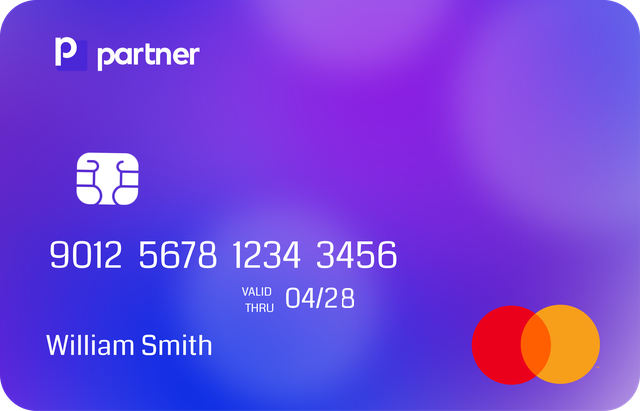
The card looks like an ordinary payment card and, in a growing number of markets, runs on an international card network. What makes it a meal voucher is not the plastic. It is the restriction: the card is only good for food, up to a fixed amount per working day, at merchants the scheme recognises.
How it differs from an ordinary prepaid card
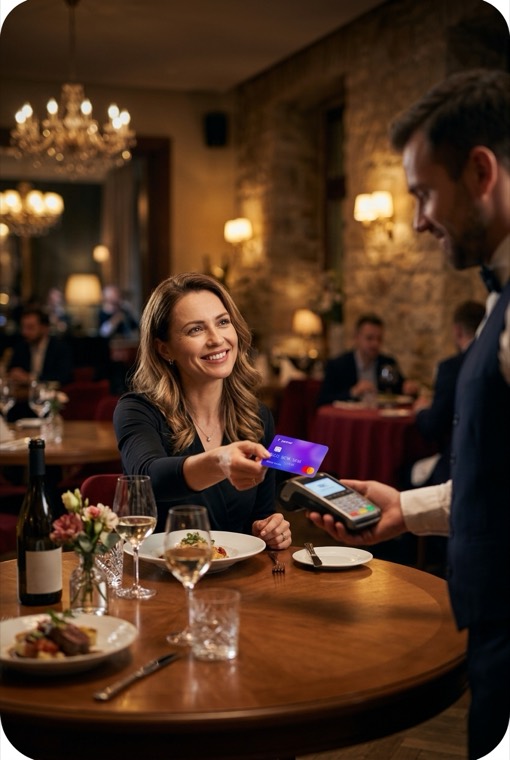
The difference sits in the authorisation, not in the reporting. An expense card lets an employee pay anywhere and sorts out the rules afterwards, by asking for receipts. A meal voucher card decides before the payment goes through: if the merchant is outside the permitted scope, the transaction is declined at the till.
That distinction matters legally as well as practically. A benefit that can be spent on anything is usually treated as cash, and taxed as cash. The restriction is what preserves the exemption.
Where can employees spend it?
Every scheme draws a boundary around food. Where exactly the boundary falls is a national decision, and it has been moving. France, for example, extended a derogation allowing any food product to be bought with a titre-restaurant until 31 December 2026, under law 2025-56 of 21 January 2025. Before that concession, the rule pointed at meals rather than groceries.
The merchant categories used in practice
Where a scheme relies on merchant category codes, these are the ones that carry the food benefit:
5812eating places and restaurants5814fast food restaurants5811caterers5462bakeries5411grocery stores and supermarkets5451dairy product stores5499miscellaneous and speciality food stores
Programmes typically offer employers a choice between a narrow scope of restaurants only and a wider scope that adds food retail. The wider scope is the more common choice across Europe, because it covers the employee who buys lunch from a supermarket shelf rather than a counter.
What is always blocked
Alcohol, tobacco, fuel, cash withdrawal and gambling sit outside every scheme. Blocking them is the minimum any programme has to do, and it is the first thing a tax authority looks at.
Who is allowed to issue meal vouchers?
In most of Europe, issuing is not open to anyone who wants to launch a card. The country keeps a register, and being on it is a precondition rather than a formality:
- Italy. The Ministry of Enterprises publishes the list of companies authorised to issue meal vouchers under legislative decree 36/2023, article 131. It named 19 companies in its update of 22 July 2026.
- France. The Commission Nationale des Titres-Restaurant lists 14 accredited issuing companies, covering paper, card and app formats.
- Belgium. The FOD Economie recognises 5 issuers. The most recent addition is Payflip, recognised in March 2026 and the first new entrant in over a decade.
- Romania. Issuers are authorised by the Ministry of Finance, and the market is served by a small number of them.
- Bulgaria. The strictest of the group. Operators are licensed and then receive a share of a national quota set in the budget act, so an employer cannot buy vouchers that fall outside somebody's allocation. The allocation is renewed annually.
- Poland. There is no register. The benefit works through an exemption from social contributions, and prepaid cards are explicitly covered.
Everywhere else on this site issuing is open, which does not mean unconditional. Greece keeps no register and still requires, by statute, a contract between the issuer and every accepting store. That pattern, a light regulatory perimeter around a strict acceptance rule, is more common than a register.
These registers are public, and they are the most reliable picture of any national market. Every country we cover has its own page, listed in the table below.
Are meal voucher cards open loop or closed loop?
Both, depending on the market, and this is the single most misunderstood part of the category. EuroCommerce, the European retail and wholesale association, describes three structures in its January 2024 position paper:
- Private network, three party. The issuer contracts each merchant directly and settles with them outside the card networks, charging a percentage of the voucher value.
- Open network, four party. The card runs on an international network with the issuer's card ranges restricted to selected merchant categories, and the merchant pays ordinary card acceptance costs.
- Mixed. The card runs on an international network, but only works at merchants that hold an additional agreement with the voucher company.
The reason the affiliated merchant network exists at all is regulatory, not technical. The European interchange fee regulation exempts instruments valid in a single member state, provided at the request of an employer or public body, regulated by a national authority for a social or tax purpose, and usable at suppliers holding a commercial agreement with the issuer. That last condition is what keeps meal vouchers outside interchange caps.
Practical consequence. In Italy, decree 122/2017 requires a contract between the issuing company and each affiliated merchant, setting out the agreed discount and payment terms. A card can still run on a card network there, but restricting acceptance by merchant category code alone does not meet the rules. In France, new entrants issue on international card networks while the four historical issuers also run the domestic CONECS network, created on 10 July 2013.
What does it cost a merchant to accept one?
More than an ordinary card, and by a wide margin. EuroCommerce reports acceptance costs up to 20 times higher than a normal consumer debit or credit card, and in Italy and Portugal between 5 and 20 percent of sales value. Food retail margins run at 1 to 3 percent, which is why this became a political issue rather than a commercial one.
Italy acted first. Since 1 September 2025 for newly issued vouchers, and across the whole market from 1 January 2026, the commission an issuer may charge an accepting merchant is capped at 5 percent. The detail sits on the Italian rules page.
Which countries have a meal voucher scheme?
per dayEE Estonia
no schemeIE Ireland
no schemeNL Netherlands
no schemeDE Germany7.67 EUR
per mealPL Poland450 PLN
per monthLT Lithuania
no schemeLV Latvia
no schemeBE Belgium10 EUR
per dayLU Luxembourg15 EUR
per voucherCZ Czechia129.50 CZK
per shiftSK Slovakia6.98 EUR
min. voucherFR France25 EUR
per dayAT Austria8 EUR
per dayHU Hungary570 000 HUF
per yearRO Romania45 RON
per dayPT Portugal10.46 EUR
per dayES Spain11 EUR
per dayIT Italy10 EUR
per daySI Slovenia
no schemeHR Croatia100 EUR
per monthBG Bulgaria102.26 EUR
per monthMT Malta
no schemeGR Greece6 EUR
per dayCY Cyprus
no scheme
- Ceiling per day
- Ceiling per month
- Per meal, shift, voucher or year
- No meal voucher scheme
| Country | Ceiling | Form | Who may issue |
|---|---|---|---|
| Austria | 8 EUR a working day in a restaurant, 2 EUR in a shop | Voucher or card | No register |
| Belgium | 10 EUR per working day, employer share capped at 8.91 EUR | Electronic only since 2016 | 5 recognised by the FOD Economie |
| Bulgaria | 102.26 EUR a month, converted from 200 BGN | Electronic since 2024 | Licensed, plus a share of a national quota |
| Croatia | 100 EUR a month flat, or 150 EUR against invoices | Transfer or card | No register |
| Czechia | 129.50 CZK a shift, the same for a voucher and a cash allowance | Card and voucher | No register |
| Finland | 8.80 to 14.00 EUR a working day, taxable value 75 percent | Card and app | No register |
| France | 25 EUR a day, employer exempt to 7.32 EUR per title | Paper issuance ends 1 January 2028 (bill) | 14 accredited by the CNTR |
| Germany | 4.57 plus 3.10 EUR per meal, and a separate 50 EUR monthly threshold | Card, restricted by merchant category | No register |
| Greece | 6.00 EUR a working day | Card | No register, but contracts with stores are required by statute |
| Hungary | 570 000 HUF a year, a recreation card rather than a meal benefit | Card | Banks, under a regulated scheme |
| Italy | 10 EUR a day electronic, 4 EUR on paper | Paper and electronic | 19 on the MIMIT register |
| Luxembourg | 15 EUR face value, employer up to 12.20 EUR | Digital only since 2025 | No register |
| Poland | 450 PLN a month exempt from social contributions | Card, coupon or voucher | No register |
| Portugal | 6.15 EUR in cash, 10.46 EUR on a card | Card | Includes bank issued cards |
| Romania | 45 RON a day | Electronic only since 2023 | Authorised by the Ministry of Finance |
| Slovakia | Minimum voucher 6.98 EUR, employer pays 3.84 to 5.12 EUR | Electronic since 2023 | No register |
| Spain | 11 EUR a working day, 9 EUR in the Basque Country | Paper, card or app | No register |
Portugal is worth watching for anyone designing a programme. Issuers there have been moving away from private affiliated networks toward open card acceptance restricted by merchant category, which is the direction the rest of the category has been drifting in.
Eight euro area countries are missing from that table because they have no scheme to describe. The Netherlands funds benefits from a general allowance, Slovenia pays a meal allowance in cash with salary, and Estonia, Lithuania, Malta and Cyprus tax an employer funded meal like pay. What applies instead is set out under countries with no meal voucher scheme.
What is changing in 2026 and 2027?
Three changes matter more than the rest. Italy capped merchant commissions at 5 percent and raised the tax exempt value of an electronic voucher from 8 to 10 EUR. France is ending paper: the government announced it in June 2025, and bill n° 2892 of 9 June 2026 sets the end of paper issuance at 1 January 2028, with paper titles issued for 2027 usable until the end of February 2028. The bill is still before Parliament. Roughly 30 percent of titles were still on paper according to the CNTR. Belgium set its ceiling at 10 EUR per working day and admitted its first new issuer in over a decade.
At European level, the revision of the payment services rules keeps the limited network exclusion but narrows it to a single limited network. Meal vouchers are not named in the agreed text, so anyone claiming the category has been brought under interchange regulation is ahead of the facts.
Every dated change sits on one page: the 2025 to 2028 calendar.
Two ways to work with us
Verestro builds the card infrastructure underneath benefit programmes. There are two ways in.
If you already issue meal vouchers and want to move volume onto cards, migrate an existing programme, or keep your own affiliated merchant list in control of every authorisation, start with how to launch a meal voucher card programme. The technical detail sits in the card issuing and core banking documentation, and the wider product range is on verestro.com.
If you are an employer looking to give your team a meal benefit, the ordering flow walks through market rules, acceptance scope and funding in one pass.